
Catfish-Chisel Reborn
The Afterlife of the Murdered King

What happened between the death of Narmer around 3100 BCE and the first inscriptional evidence for the Osiris cult in the Pyramid Texts eight centuries later? A cult so central to Egyptian religion could not have suddenly materialized out of nowhere. If it was founded upon the murder of Egypt’s legendary king, then its memory must have persisted over the centuries, unspoken, guarded, and deliberately concealed by the ỉrỉ-pat, Egypt’s hereditary ruling elite who shaped the kingdom’s religious and symbolic order. 1
The primary god of this ruling elite, going back to their initial appearance in Egypt and their first major settlement at Hierakonpolis, was Horus, whose symbol from the very beginning was the falcon.
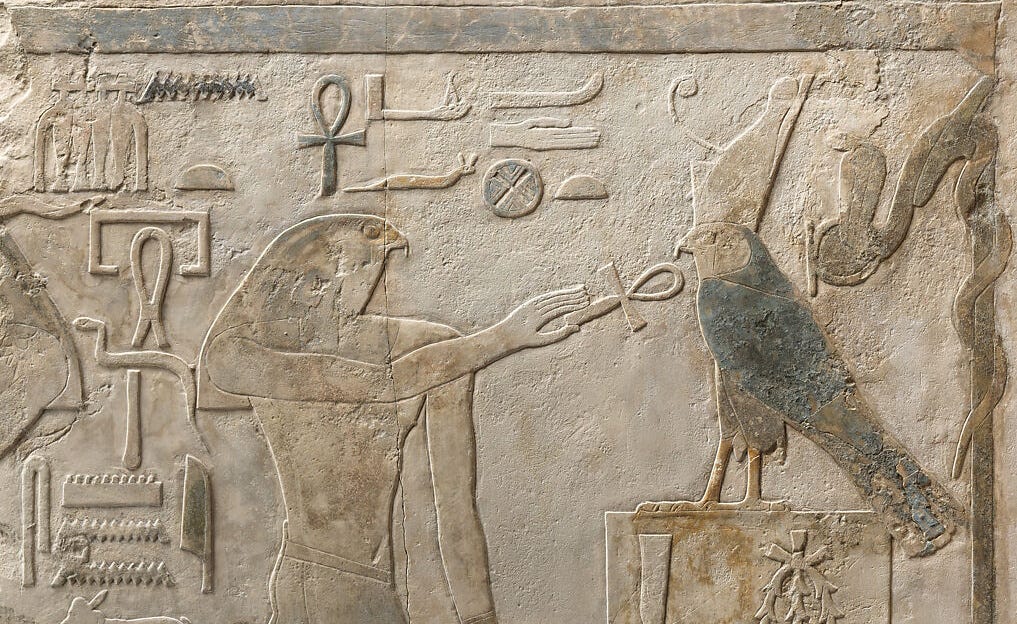
Historian David Rohl does an excellent job arguing that the origin of the Falcon Tribe was the Persian Gulf, and before that, Eridu in Mesopotamia. The leaders of this tribe were likely blood relatives of the ruling families of Uruk, and they carried with them the same technologies that had allowed Uruk to emerge as history’s first State.2
As difficult as it may be for mainstream Egyptologists to swallow, the evidence strongly supports David Rohl’s contention and Flinders Petrie’s original view that Egypt was invaded and conquered by a technologically-superior and genetically-distinct group of colonizers from Mesopotamia who established the governmental and religious foundations of Dynastic Egypt.
Egypt’s Earliest Gods
We can catalogue Egypt’s earliest gods through symbols and inscriptions on predynastic and early dynastic artifacts, as well as through archaeological evidence for early shrines and temples. In Egypt’s earliest layers divinity is overwhelmingly animalistic. Gods are forces embedded in the living landscape itself. This reflects the spirituality of human communities living in close relationship with the Nile, the desert, and the animals that sustained and threatened them. Nature was both giver and destroyer that must be venerated, feared, and at times appeased through ritual. The sacred, at this stage, is inseparable from the rhythms, gifts, and dangers of the natural world.
This symbolic world shifted dramatically with the arrival of a technologically advanced and aggressively dominant ruling power that imposed itself upon Egypt’s indigenous population. With this transformation, the experience of power itself changed and Egyptian spirituality changed with it. Animal forms did not disappear, but their meaning was changed. No longer simply embodiments of natural forces, animal totems became emblems of authority, conquest, and control. The Horus falcon was a predator that struck from above. The Seth animal was a fearful monster or hybrid beast. The scorpion and the cobra signified lethal aggression and danger. The bull embodied strength, virility, and dominance. In this evolving symbolic language animals no longer represented humanity’s place within nature, but rather nature itself being harnessed, weaponized, and mythologized in the service of political power.
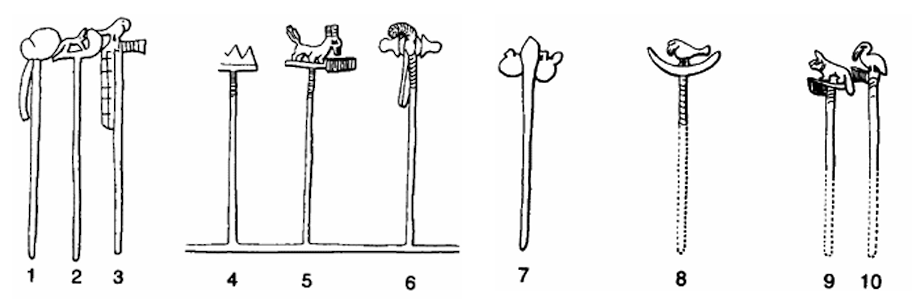
Consider the different totems that appear on standards found on predynastic and early dynastic artifacts up to and including Narmer:
In the table below the most notable early deities are listed, along with all of the known cult locations of the various gods and goddesses that were honored and worshiped into Early Dynastic times. The Inscriptional column notes those deities that appear on standards (St), as well as the time that inscriptional evidence first shows up, whether before Narmer (Pre) or after he established the First Dynasty (Early). The Archaeo column indicates the time (Pre- or Early Dynastic) that archaeological evidence for the first appearance of the god’s associated temple or shrine has been found, if at all.
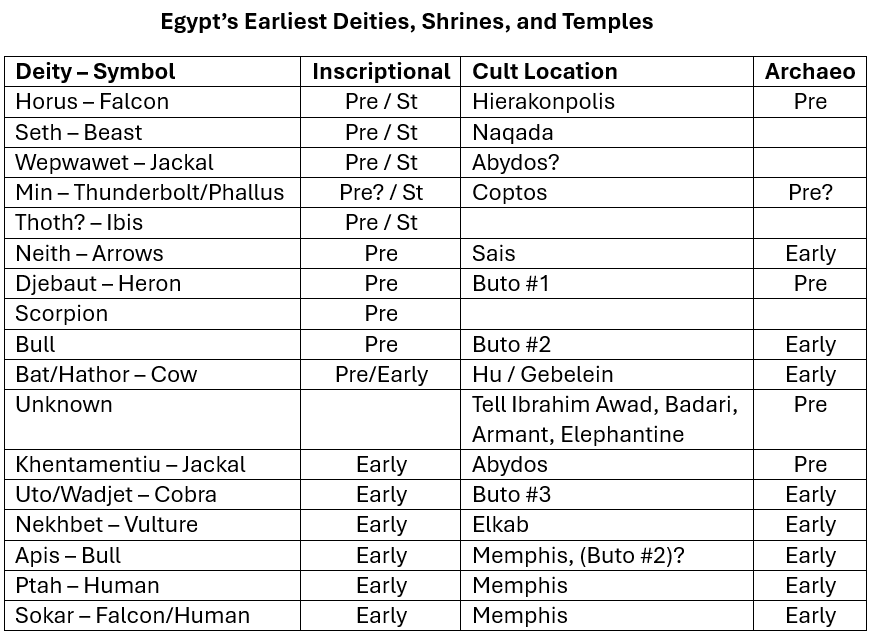
After the shocking and unexpected “hippo encounter”3 that took the life of Narmer, what we find above is essentially the sacred landscape that Egypt’s ruling elite had to work with, to shore up the foundations of their kingdom and to cover up the destabilizing trauma of regicide. If we analyze the artifacts of Narmer we can discover clues and data points involving these same deities that allow us to track his cult through time and perhaps recognize the strategies used by the ỉrỉ-pat to control his memory, protect their position, and maintain the stability of their kingdom.
The Sacred World of Narmer
The primary deities inscribed on the Narmer Palette are Horus and Bat, as well as the Royal Placenta, Wepwawet, and two separate Horus-Falcons on the four standards carried by attendants. A connection to Seth is also suggested by Narmer wearing the Red Crown, which was in predynastic times associated with rulership of the tribe of Seth, with the White Crown indicating the tribe of Horus. On the palette there are also two images suggesting a connection to a bull cult, most obviously with Narmer in the form of a bull trampling a settlement, but less obviously by the bull tail worn by Narmer standing in his smiting pose. This bull tail also shows up worn by King Scorpion on the Scorpion Macehead, so we know that the bull was likely a sacred sign of royal power that was already present in the traditions of Upper Egypt when Narmer arrived.
Turning to the Narmer Macehead, the vulture depicted over the shrine in which red-crowned Narmer sits may be the goddess Nekhbet (perhaps signifying an Upper Egyptian locale), but on the other hand the heron in a separate scene may be the deity Djebaut (and therefore signify the shrine’s location in Buto). The macehead also depicts the same four standards featured on the Narmer Palette, as well as antelopes captured in a pen to symbolize Narmer’s mastery over nature. The antelope does not appear to be deified by early Egyptians, yet the symbol becomes part of Narmer’s story, as we will see.
The goddess Neith is also associated with Narmer by the fact that the name of his wife was Neithotep, or Neith-hotep, meaning “Neith is satisfied.” Wilkinson shares more:
Neith was a warlike goddess whose name perhaps means ‘the terrifying one’. Her symbol, the crossed arrows, occurs as early as the Predynastic period, and Neith was clearly an important deity at the very beginning of the Early Dynastic period… A label of Aha seems to record a royal visit to the shrine of Neith. This was probably located at Saïs in the north-western Delta, the principal cult centre of Neith in historic times. 4
Two other deities closely associated with Narmer are the Apis Bull and the god Ptah, and Narmer’s identification with Menes is crucial to understand this connection. According to later tradition, Menes founded Memphis, established the Temple of Ptah, and instituted the Apis Bull cult, which would remain headquartered at Memphis for millennia. This places Menes aka Narmer at the very center of a powerful constellation of religious symbols linking kingship, craftsmanship, creation, and bovine strength. These associations are not incidental and all of them eventually circle back around to Osiris.
Complicating this picture is evidence for a parallel bull cult at Buto. Predynastic imagery depicts a shrine at Buto, but during the reign of Hor-Aha a new image appears in which a bull occupies a central position within the shrine itself. There is also archaeological evidence for a bull shrine at Buto during this time. This raises an important question: are we witnessing the emergence of the Apis Bull cult in the Delta, later transferred to Memphis? Or does this represent a distinct, perhaps short-lived bull cult, established either by Narmer or his heir Hor-Aha, that was eventually eclipsed by the more dominant Memphite tradition? 5
In either scenario, the evidence points to a deliberate linkage between Narmer, bovine symbolism, and the theology of divine kingship. This linkage ultimately feeds into the Osiris tradition, where death, regeneration, bull symbolism, and royal power converge. To understand how this symbolic system cohered, however, we must first examine the role of Ptah, whose theology underwrites both the state cult established at Memphis and the deeper metaphysical framework into which the Apis Bull and Osiris were absorbed.
Ptah: Creator, Builder, Craftsman
Before Ptah, Egyptian gods are overwhelmingly zoomorphic and reflect the totemic, clan-based religion of the predynastic world. But after the rise of Narmer something unprecedented takes place: Ptah appears as a Creator god portrayed in fully human form. 6
Religion within the framework of Civilization is always an expression of power, focused on what is feared, obeyed, or revered. Narmer’s authority, manifested through state-building, monumental planning, and political unification, was unlike anything Egypt had ever seen. Thus Ptah emerges as the first anthropomorphic god of Egypt, the divine embodiment of the builder-king’s creative and shaping force. The god is human because the most awe-inspiring power in Egypt had become human: the king himself.
The god Ptah was one of the major deities of Egypt, yet surprisingly little is known about his early history… Ptah is known to have been worshiped as early as the Early Dynastic period, the date of his image on a stone vessel found at Tarkhan… There he is shown in his usual anthropoid form without indication of limbs—a form that he shares with some other ancient gods such as Min and Osiris—that was later interpreted as the form of a mummy. Wearing a tight-fitting skullcap, he stands on a pedestal in an open shrine, holding a scepter. 7
The emergence of Ptah and the nature of his attributes are very provocative, especially his appearance as mummified, as human, as holding a scepter. Later, Ptah is depicted with green skin, and given the epithet “Lord of Ma’at.” Strangely, all of these attributes later migrate to become part of Osiris.
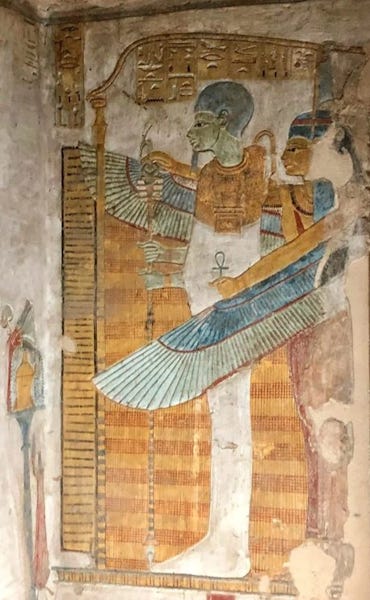
There is another Narmer connection with Ptah that is worth pointing out. The name Narmer is written with the signs catfish–chisel, which we identify as congruent with “fisherman,” but may encode more than just that. The chisel (mr) is one of the oldest symbols of craftsmanship in Egypt, directly tied to carving, shaping, and building, which are the very functions that came to define Ptah and his cult. As the unifier of Egypt and founder of Memphis, Narmer is remembered as the human “shaper” of the Two Lands, establishing order through acts of construction, planning, and statecraft. Ptah, whose earliest visual attestation appears only a few generations later (in the reign of Den), embodies this same craftsman ideal on the divine level: he is the cosmic sculptor who shapes Creation itself.
The parallel is striking. Narmer stands as the human architect who designs and shapes the modern Egyptian state into existence, while Ptah emerges as the divine architect who is credited with designing and shaping the cosmos into form. Thus, the chisel in Narmer’s name may represent the earliest symbolic seed of the Memphite craftsman theology that came to flourish in the Cult of Ptah. The meaning of the name itself supports this line of thinking:
An etymology found in the Coffin Texts (Spell 647) connects it with a verb ptḥ (“to fashion”), but although this would obviously agree well with his role of divine craftsman, it is also possible that the verb is actually derived from the god’s name rather than the other way round. 8
Let’s be clear that we are not saying Ptah was established in Memphis as the deification of the king, whether Narmer or any other. In Egypt the king was already known to be the living embodiment of Horus, so the wholesale invention of a new god to serve a function already taken makes little sense.
A more plausible alternative is that Ptah was modelled on a pre-existent god imported and adapted to Egyptian culture specifically as a civilizational and human-imaged god. Ptah was a god made in man’s image and established to serve the ỉrỉ-pat’s needs as rulers of their kingdom. Our foundational thesis is that Narmer came from the royal house of Uruk and is the same person named as “Dumuzi the Fisherman” on the Sumerian King List (see “Uruk on the Nile”). Considering all of Narmer’s accomplishments in organizing, building, unifying, and establishing Egypt as a modern kingdom on par with Uruk, it would make sense for Narmer to establish an Egyptian cultural version of the anthropomorphic Sumerian god who stood behind the civilizational achievements of Uruk. Narmer, and the Falcon Tribe with whom he was both allied and genetically related, would have known the Sumerian identity of this god intimately.
That god was Enki.
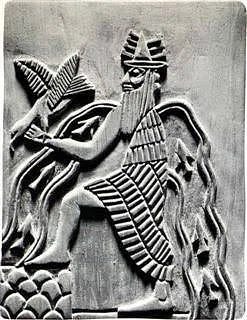
In Sumerian tradition Enki appears as an anthropomorphic god (often accompanied by a falcon) who is explicitly viewed as a creator, shaper, and molder. In creation myths he devises the method by which humans are made from clay mixed with divine substance. Enki is also the architect and holder of the me, which are the arts, crafts, technologies, and institutions of civilization. This conception closely parallels Ptah’s identification with “fashioning,” situating both deities within an early Near Eastern model of creation as the shaping of civilized order through intellect and craft.9
Much like Ptah, Enki is a mysterious and enigmatic god, and this study is not the first to draw parallels between the two. Here is Michael Rice:
Ptah of Memphis…. bears many of the qualities of the amiable Enki of Eridu in Sumer. Ptah was, like Enki, the ‘Lord of Earth’; it was said of him ‘all gods, all men, cattle, creeping things, everything that lives is Ptah’. He was hailed as Lord of Destiny, Lord of Truth, Master of Fate. He was amongst the most enduring and the most sympathetic of all the gods; in the Memphite theology, developed by Ptah’s priests, it was even suggested that all Egypt’s gods were actually manifestations of Ptah. 10
David Rohl’s conclusion is much more blunt:
Ptah, the creator-god of the Egyptians, may be identified with the Sumerian creator-god Enki, whose primeval temple was built by the waters of the abzu at Eridu. 11
The correlation is concrete, yet the influence of Narmer on the origin and nature of Ptah’s representation still remains and must also be taken into account.
The Festival of Sokar and the Commemoration of Narmer
The falcon-headed god Sokar emerges as one of the earliest funerary gods of Egypt, and appears in the record as far back as the First Dynasty. Sokar’s cult was foundational to the Memphite burial landscape itself and the great Saqqara necropolis west of Memphis derives its very name from Sokar (Skr). It is through the cult of Sokar that we find a pre-Osirian funerary tradition in which royal death was managed long before mythic resurrection publicly entered the picture through the Old Kingdom reforms of the Heliopolitan priesthood.
The name of Sokar first appears not in mythological narratives but in royal year labels and annalistic records, where the Festival of Sokar is recorded to have been celebrated as far back as the First Dynasty, indicating a cult defined by ritual and calendar rather than narrative or theology.
The earliest evidence for something like a “Festival of Sokar” is pointed out by Wilkinson as appearing on scenes on an ivory label featuring Hor-Aha’s name in a serekh, which was found in Queen Neithotep’s tomb at Naqada. Remember that Neithotep was the wife of Narmer and mother of Hor-Aha. We have already speculated that she later became deified as Isis the sister-wife of Osiris where her mythical accomplishments parallel the historical accomplishments of securing the realm after the death of her husband Narmer (Osiris) on behalf of her son Hor-Aha (Horus the younger). In Wilkinson’s words: “The earliest depiction of a bark resembling the Henu-bark of Sokar appears on the Naqada label of Aha.” 12
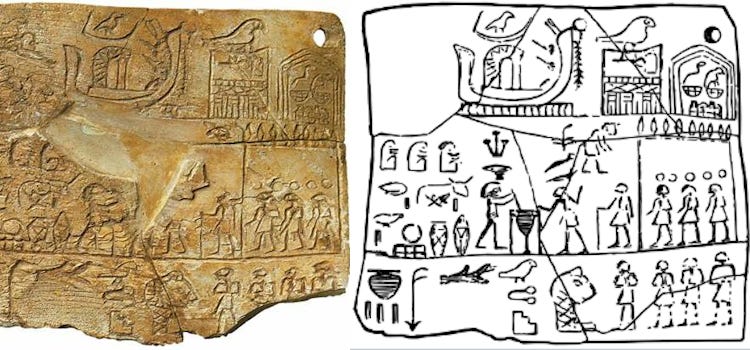
We turn now to Egyptologist Jacques Kinnaer13 for a description and interpretation of what the Naqada Label reveals:
In the upper register, to the right, a construction with a triangular roof is represented. Inside it, there are a vulture and a snake, both sitting on a basket. They symbolise the “Two Ladies (nb.tj)”, the goddesses Nekhbet and Uto, the protective goddesses of Upper and Lower Egypt respectively. Under the goddesses there is a low rectangular sign that is divided in two rows, each row containing 6 squares. The rectangle is topped by a combination of a triangle with a bow, which is repeated twice. To the left of this group the Horus-name of Aha is shown in a serekh. This is followed by a representation of a boat. It is ornamented in such a way that it is presumably a ritual boat. There are traces of water surface under the boat.
The ritual boat to the left of the serekh-name of Hor-Aha is what Wilkinson identifies as an early prototype of the “Henu-bark of Sokar” that is central to the Festival of Sokar mentioned in later First Dynasty records. Wilkinson explains that this festival was in later times “the most prominent festival involving a divine bark” upon which “a stone, perhaps a cultic image of the deity” was placed, with the boat attached to a sledge and ritually dragged across the fields. Unfortunately, images of Sokar before the Middle Kingdom are virtually nonexistent, but after they do appear Sokar is syncretized with Osiris, appearing as a falcon-headed mummified figure, often wearing the White Crown.
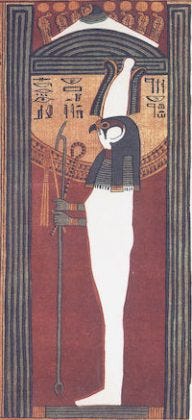
Going back to Kinnaer’s interpretation of the Naqada Label, he offers a footnote to explain what the symbols within the triangle-roofed structure pictured at the top right of the label represent:
It is part of the construction with the vulture and snake, and the serekh of Aha, that has been preserved on the fragment found at Umm el-Qa’ab. The sign underneath the two goddesses is drawn much clearer on this fragment. It resembles other Early Dynastic examples of the hieroglyph mn.
For those who are closely following this is already very significant to our thesis, but let’s keep going and see how Kinnaer spells it out.
For the German Egyptologist Borchhardt it was clear that the group in the construction with the triangular top is a Nebti-name. According to him the sign underneath the symbols of the two goddesses clearly represents the hieroglyph mn, which made him interpret the whole group as the Nebti-name of Men(es)…
Grdsloff also pointed out the fact that this Nebti-name is written in a sign that represents a tent. Referring to the Pyramid texts of the late 5th and the 6th Dynasty, he linked this construction to the burial chapel where the cult of the deceased king was celebrated. Since the Nebti-name of Menes was written in a funerary booth, he concluded that this king was already deceased during the reign of Aha. As it was typical for the successor (Horus) to maintain the cult of his deceased predecessor (Osiris), Grdsloff concluded that Menes must therefore have been Aha’s immediate predecessor, the Horus Narmer.
So on the right of the serekh-name of Hor-Aha we have what can be interpreted as the burial chapel of Narmer, and on the left we have a cult object within a shrine placed on a bark, with the Horus falcon depicted above it. The cult object is narrow and elongated, similar to what we might expect for an image of a wrapped body, long before the ỉrỉ-pat had perfected the craft of mummification.
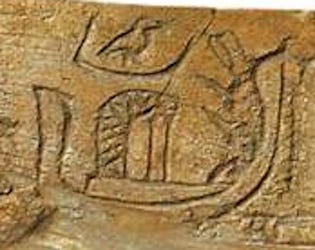
What we are seeing may be the very foundational components of what became the canonical image of Sokar: a falcon’s head attached to a human body.
Seen in this light the Naqada Label of Hor-Aha can be understood as preserving the earliest visual evidence for the ritual commemoration of Narmer after his death. The bark scene on the left and the funerary Nebti-construction on the right are not unrelated motifs, but complementary halves of a single program: the management and containment of the royal body, and the institutionalization of the dead king’s cult.
This new reading allows the emergence of Sokar to be understood not as a generic funerary god with roots in fertility and agriculture, but as the ritual crystallization of a specific historical memory. What begins here as the river-borne procession of a wrapped royal body beneath the falcon god’s protection gradually acquires a name, a festival, and eventually an iconographic synthesis in which falcon and corpse merge into a single mummiform being. In this sense, the so-called “god” Sokar is not the origin of the ritual, but its personification, born from repeated commemorative practice. Only much later does the Sokar tradition naturally merge back into the Osiris mythos that finally supplies the underlying narrative and cosmic meaning… to what began as the urgent, politically-charged problem of dealing with the trauma of a legendary yet brutally murdered founding king.
The Festival of Sokar is one of the oldest religious festivals in Egypt, recorded as such beginning with a label found in the tomb of Qa’a, the eighth and final king of the First Dynasty. However the Palermo Stone indicates that the festival was also celebrated by Den (the fifth king of the First Dynasty), and by the time of Ninetjer in the Second Dynasty the festival was celebrated regularly every six years. 14
By the Middle Kingdom, following the Heliopolitan reconfiguration of Egyptian theology, a parallel ritual cycle commemorating the death and renewal of Osiris had taken formal shape in the month of Khoiak. The most important evidence for this development is the stela of Ikhernofret (Berlin Museum 1204), erected circa 1870 BCE. This text describes a ritual procession from the Osiris Temple at Abydos to the god’s tomb at Peker (Umm el-Qaab), employing three principal barks. Central among these was the primary bark, explicitly named “Truly-arisen-is-the-Lord-of-Abydos,” which bore the shrine containing the effigy of Osiris himself. The ritual emphasis falls squarely on the transport, burial, and renewal of a once-living ruler, presenting the Khoiak Festival as a developed continuation of themes already present in the much older Festival of Sokar.
However, rather than being displaced by the rise of Osirian theology, the Festival of Sokar persisted alongside the Khoiak rites well into the New Kingdom. Nineteenth Dynasty reliefs from the Temple of Seti I at Abydos preserve Sokar’s ritual in detail, centering on the distinctive henu-bark and a god laid upon a funerary bier. Significantly, the recumbent figure is explicitly named in the inscriptions. In some scenes he is “Sokar-Osiris who-is-in-his-bark,” and in others “Osiris-Wennefer.” These titles do not indicate competing deities but alternative ritual designations applied to the same figure, whose revivification formed the core of the festival’s mysteries. In ritual practice, Sokar was not merely associated with Osiris; he was recognized as Osiris, the slain king whose body was ceremonially enclosed and conveyed, and whose memory was ritually restored to potency as the divine Lord of the Dead.
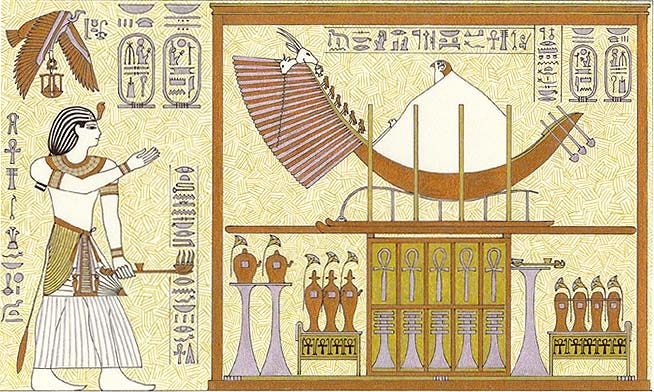
The physical form of Sokar’s bark is known with unusual precision through repeated New Kingdom reliefs and accompanying captions. These consistently depict the henu-bark as a sled-mounted ritual vessel with a crescent-shaped hull and a fixed set of symbolic ornaments, most notably the forward-facing bull-head and backward-facing antelope-head15 at the prow, followed by a fish, alongside falcons and protective emblems. The consistency of this iconography indicates a formally defined cult object rather than generic funerary symbolism. Taken together, the convergence of bull, antelope, and fish imagery on the central bark unmistakably recalls the earliest royal symbolism of Narmer himself, suggesting that the Sokar–Osiris rites preserved not an abstract myth, but the ritualized memory of a specific slain ruler carried forward from the very dawn of Egyptian kingship. 16
The Origins series from Sky Gods and Sacrifice
Read next: Part Twelve (coming soon)
Or go to Full Index
Peter Goodgame
December 26, 2025
Kailua, Hawaii
As Toby Wilkinson notes, the title ỉrỉ-pat, conventionally translated as “hereditary prince,” denoted membership in a closed and inherited elite whose authority derived from lineage rather than from any specific office. In Early Dynastic Egypt, such titles marked those who stood closest to the foundations of kingship itself, forming an inner circle bound by ancestry, privilege, and continuity across generations. Wilkinson writes, “The formal separation of the ruling class from the rest of the population provides a valuable insight into the mechanisms of early royal government in Egypt. It appears that access to political power was carefully restricted, to enhance the absolute authority of the kingship and emphasise its supernatural remoteness from the general populace.” It was this elite and insulated class, more than any other group, that possessed the authority, the longevity, and the technology required to shape Egypt’s sacred worldview and to safeguard dangerous historical memory. See Toby Wilkinson, Early Dynastic Egypt (London: Routledge, 1999), pages 115, 157.
For more on the connections between Egypt’s Horus-worshiping Falcon Tribe and the city-state of Uruk see our previous essays, as well as the work of David Rohl, especially his book Legend: The Genesis of Civilisation (London: Century, 1998).
Wilkinson, page 252.
Wilkinson, page 274.
“The majority of the high gods of Egypt have an animal persona; only Ptah, who is one of the greatest of the divine powers, is invariably shown in human form…” Michael Rice, Egypt’s Making: The Origins of Ancient Egypt 5000–2000 BC (London: Routledge, 1990), page 260.
Jacobus van Dijk, “Ptah,” in The Oxford Encyclopedia of Ancient Egypt, ed. Donald B. Redford, vol. 3 (Oxford: Oxford University Press, 2001), page 74.
van Dijk, “Ptah,” page 75.
Samuel Noah Kramer’s overview of Enki was entitled Myths of Enki, the Crafty God, although crafty in Kramer’s intended sense speaks of wisdom and cunning.
Rice, page 58.
Rohl, page 347.
Wilkinson, page 261.
Jacques Kinnaer, “The Naqada Label and the Identification of Menes,” Göttinger Miszellen (2003), accessed via Academia.edu.
Wilkinson, pages 68, 71-72, 260-261.
Antelopes feature on the Narmer Macehead within an oval that scholars see emblematic of the predynastic Horus-temple at Hierakonpolis, symbolic of the king’s powers over wild nature. See Liam McNamara’s analysis in Part Eight, “Egypt Takes Off.”
For a more in-depth analysis of the Sokar and Khoiak festivals and the specific components of the henu-bark refer to: Katherine J. Eaton, “The Festivals of Osiris and Sokar in the Month of Khoiak: The Evidence from Nineteenth Dynasty Royal Monuments at Abydos,” Studien zur Altägyptischen Kultur 35 (2006): pages 75–101.
I'm still putting together all of these clues, so I'll write down some thoughts on this together with my research. Those who came from Hierakonpolis can be assumed to be the Hieros--not describing the indigenous population from Sumer but ruling caste from elsewhere. They are a 'genetically-distinct group of colonizers ... who established the governmental and religious foundations of Dynastic Egypt.'
Were they technologically superior? They never built anything like the Great Pyramid, whose blocks couldn't be moved with any amount of manpower. They defaced Mehit the lioness and replaced her head with a Pharaoh. Their social organization and economic structure was reliant on slavery, not reciprocity. Weaponry seems like their main technology, and that's more about intent, since a weapon is just a tool being used for malevolent purposes.
The important question is which gender gives birth. Ptah isn't just a master craftsman, he's fashioning people out of clay--an elaborate fantasy to obscure the obvious fact that females give birth, something that no one questioned before this cult--that creation came from a mother.
Iri-pat is an interesting term. Iri is like heiri or Ary of Aryans. And pat is similar to Dyeus Patr, the sky father god of the heiros/ Aryans. So they could be seen as the patri-archons or heirs of the sky father god. I think the chisel is rewriting the narrative of the creatress into a creator god.
The falcon may be pre-dynastic to Egypt but came from Hierokonpolis from which the concept of dynastic rule originates. The animal representations seems like it's missing the pre-dynastic Mehit or Ua Zit, the great serpent. And I think Nekhebt the vulture is prehistoric, so pre-dynastic. Neith, represented by arrows is heiros, of course--a symbol of conquest.
Enjoying the conversation, Peter!