
Apotheosis
The Occult Origins of Osiris

“The mysteries of Osiris are hidden; they are secret; they are not to be spoken of. He who speaks them dies a second death.” — Ceiling inscription at the Temple of Hathor at Dendera1
In mainstream Egyptology, Osiris is generally understood to have originated as a mythic personification of agricultural renewal and cosmic order rather than as a historic individual. His death and restoration are interpreted as symbolic expressions of the seasonal cycle: the decline of vegetation near the end of Fall, and its resurgence with the return of new life in the Spring. Within this framework, the Osirian cult is seen as emerging from pre-dynastic agrarian spirituality, in which natural processes were gradually personified and woven into increasingly complex mythic narratives. The portrayal of Osiris as a murdered king who takes the position of judge of the dead is therefore treated as a secondary development, reflecting the growing political and ideological needs of the Egyptian state rather than the memory of an actual ruler who lived and died.
The argument advanced in this series challenges that sequence. Rather than a vegetation, cosmic, or purely chthonic deity who was later royalized, the evidence suggests that the figure of the living king came first: a flesh-and-blood ruler whose death left a deep and lasting imprint on the early Egyptian state. From this perspective, the Osiris Cult began not as a symbolic or spiritual meditation on nature, but as a form of ancestor veneration anchored in the memory of a transformative human figure and his traumatic death. As Egyptian state power expanded and its theology matured, this foundational cult absorbed additional layers of meaning, incorporating agricultural, seasonal, and cosmic symbolism into the Osiris tradition.
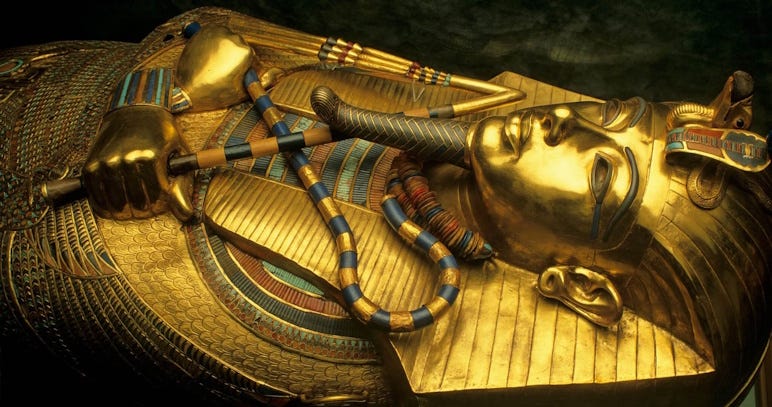
The task at hand then, is to document how the cult began and how it evolved into the central mystery of Egyptian religion that impacted all of western civilization that followed. Author Robert Bauval introduces the challenge that we are up against:
There is a great paradox in Egyptology that so far has not been properly explained. Although the earliest reference to Osiris is found in the Pyramid Texts which date from c.2300 BC, a cursory study reveals that the mythology, doctrines, liturgy and rituals which they contain could not possibly have developed overnight, but would have required a long process of intellectual and religious evolution long before that date. Although all Egyptologists seem to agree to this, none can agree, however, on how long before that date this process would have begun… Furthermore, the Egyptologists are also at a loss to explain why in the large quantities of inscriptions that predate the Pyramid Texts, not one single mention of Osiris has been found. It is as if the cult of Osiris, with its rituals, doctrines, liturgies and mythology, suddenly materialised out of nowhere and, almost overnight, was readily adopted as the principle religion of the pharaonic state. 2
Bauval’s view is that the origins of Osiris go back to the magical date of 10,500 BCE, a view that parallels Graham Hancock and other “ancient civilizations” theorists. This view attempts to connect Egypt to the mythical Atlantis spoken of by Plato. Although it has been successfully commercialized in books and on television, with a huge following on social media, it must be pointed out that this particular date, drawn from a single reference in the works of Plato, is also dependent upon the legends and psuedo-histories of Freemasonic lore as well as the channeled messages of Edgar Cayce. Although attractive for some, this view is demonstrably problematic, as authors Lynn Picknett and Clive Prince show in their 1999 book, The Stargate Conspiracy: The Truth About Extraterrestrial Life and the Mysteries of Ancient Egypt.
Regardless of any Egyptian connection with Plato’s Atlantis or not, when it comes to Osiris the truth is that we do not need to go back thousands of years to find the origin of the Osiris Cult. The myths and legends of Osiris tell us themselves that Osiris was the great civilizing founder of Egypt, so the logical starting point for understanding the Cult of Osiris is eight hundred years before the first Pyramid Texts to the time of the historical foundation of the Egyptian state. That is where we discover Osiris walking the earth in his original form as King Narmer, aka Menes, the unifier and founder of Dynastic Egypt.
The Foundational Trauma
Egyptologists are largely in agreement that Menes is simply the “Sedge and Bee” (nswt-bity) name of Narmer. If we look at all of the accomplishments of Menes/Narmer and compare them with the accomplishments attributed to Osiris we find a very clear and obvious overlap.
Consider first the introduction of the god Osiris as written by Plutarch in his lengthy exposé, On Isis and Osiris, written around 110 CE, which was the first full-length public treatment3 of Egypt’s foremost cult and its mysteries:
One of the first acts related of Osiris in his reign was to deliver the Egyptians from their destitute and brutish manner of living. This he did by showing them the fruits of cultivation, by giving them laws, and by teaching them to honour the gods. Later he travelled over the whole earth civilizing it without the slightest need of arms… 4
For Plutarch, Osiris was the great civilizer—not only of Egypt but of the entire world. He credits Osiris with establishing the three essential pillars of civilized society: agriculture, law, and religion. According to Plutarch, Osiris was a flesh-and-blood king who reigned for twenty-eight years5 before his unexpected and violent death.
Right from the introduction we can see that the simplest explanation is the most logical. The ancient historians identify Osiris as the god-king who brought civilization to Egypt, and then when we exclude the mythical and turn to the historical, we find that Menes is similarly credited by the historians for bringing Egypt into the light of civilization. (See our previous essay on King Menes). Not only that, but Menes is also remembered as having suffered an unexpected and violent death, which is the event hidden at the very heart of the Osirian mystery tradition.
In the aftermath of the unexpected death of their founder the Egyptian ruling elite faced a daunting task. How could they honor and revere, after his tragic death, the illustrious king that they had lauded and exalted as a god during his life?
Consider once again the symbols that appear on the Gebel el-Arak knife handle, the Narmer Palette, and the other associated artifacts that pictured the legendary figure.
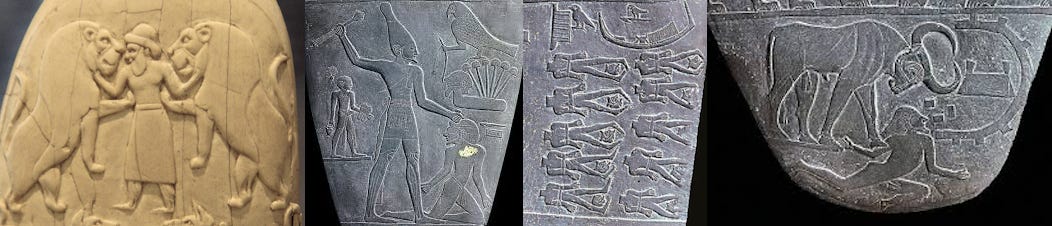
These images exude hubris.
They project invincibility.
They are designed to inspire awe and compel submission to an all-powerful dominant authority who has been established, blessed, and protected by the gods.
And yet, despite this fabricated aura of divine supremacy, the supposedly immortal ruler was mercilessly and irrevocably cut down in his prime. This contradiction—this rupture between the propaganda of the ruling class and the stark reality of the king’s death by human hands and final end as a lifeless corpse—marks what can only be called Egypt’s Foundational Trauma at the very genesis of their civilization.
It is no wonder then that the priests of Egypt were sworn to secrecy regarding the circumstances of the death of Osiris.
In the end, as the passage of centuries helped to heal the wound, what finally emerged was the myth of a legendary king killed not by human hands, but by another god, and narrated within the context of the very real historical rivalry between the two tribes of Horus and Seth.
A Murder Concealed
We have already mentioned Plutarch, who was able to publish his own account of the life and death of Osiris around 110 CE, long after the mysteries of the Osiris Cult ceased to be protected by the Egyptian state. It is unfortunate that Plutarch’s treatise comes over three thousand years after the founding of Dynastic Egypt, which gives room for Egyptologists to dismiss it entirely and bring forth their own imaginative origin theories. Yet the essential details that Plutarch reveals regarding the murder of Osiris at the hands of Seth are actually supported by the very earliest Egyptian sources.
Our first insight into the Osiris Cult comes from the Pyramid Texts, a collection of spells that were inscribed on the walls of small funerary pyramids built by Fifth and Sixth Dynasty kings at Saqqara, starting with King Unas circa 2350 BCE. We must be clear that these texts were not created for public viewing, but were written to aid the deceased king in his journey to the afterlife. So although these texts speak of Osiris being murdered by Seth and the subsequent battle between Horus and Seth, the story remained hidden within the priesthoods of Egypt.
The Coffin Texts, which emerge at the end of the Old Kingdom and become widespread during the Middle Kingdom (c. 2100–1700 BCE), mark a significant expansion of the Osiris Cult. These spells were inscribed on the coffins of elites, showing that identification with Osiris was no longer exclusive to royalty. Yet the narrative itself remained unchanged: Osiris is murdered by Seth, mourned and restored by Isis and Nephthys, and avenged by Horus. The deceased is repeatedly addressed as Osiris, indicating that Osiris was understood as the archetypal dead king whose status as lord of the dead could be ritually shared.
This tradition reaches its most familiar form in the Egyptian Book of the Dead, compiled mainly during the New Kingdom (c. 1550–1070 BCE) but drawing on older material. Osiris reigns as the judge and lord of the dead and the deceased seeks to follow the same path once taken by Osiris—death, justification, and restoration in the land of the dead. At no point do Egyptian texts present Osiris as an abstraction, a mere symbol, or as a seasonal metaphor.
A crucial articulation of this memory appears in the “Great Hymn to Osiris” inscribed on the Stela of Amenmose in the early 18th Dynasty, circa 1450 BCE. The hymn describes Osiris not as an abstract or primordial deity, but as a once-living king, son of Geb, who was “heir to the kingship of the Two Lands,” i.e. Egypt. His murder is treated as a violent rupture that demanded mourning, restoration, and eventual vindication, culminating in the rightful succession of Horus. Only after his unjust killing does Osiris become lord of the dead, his divine authority rooted in a prior human reign. The hymn therefore preserves a clear memory of Osiris as a historical ruler whose death and transformation lay at the foundation of the Egyptian state.
Across all of these Egyptian sources—spanning over a dozen centuries—Osiris is consistently remembered as the slain king whose death shaped Egypt’s understanding of kingship, justice, and the afterlife. Throughout this long tradition, the deeper meanings of the cult and its mysteries remained largely restricted to priestly and elite circles, rather than being openly shared with the wider population.
Six centuries after the New Kingdom period the Greek historian Herodotus visited Egypt while it was under Persian rule, around 440 BCE. Known as the “Father of History” for his pioneering nine-volume Histories, he traveled extensively throughout the country gathering information firsthand. Although he appears to have gained the confidence of those initiated into the sacred traditions, he deliberately refrained in his writings from naming Osiris as the central figure of the mysteries:
The Egyptians hold solemn assemblies not once in the year, but often… the most zealously celebrated is at the town of Bubastis in honour of Artemis, and the next is that in honour of Isis at Busiris. This town is in the middle of the Egyptian Delta, and there is in it a very great temple of Isis... The third greatest festival is at Sais in honour of Athene… When the people are on their way to Bubastis they go by river… [W]hen they have reached Bubastis, they make a festival with great sacrifices, and more wine is drunk at this feast than in the whole year beside. Men and women (but not children) are wont to assemble then to the number of seven hundred thousand. I have already told how they keep the feast of Isis at Busiris. There, after the sacrifice, all the men and women lament, in countless numbers; but it were profane for me to say who it is for whom they lament. 6
There is also at Sais the burial-place of him whose name I deem it forbidden to utter in speaking of such a matter; it is in the temple of Athene, behind and close to the whole length of the wall of the shrine. Moreover great stone obelisks stand in the precinct; and there is a lake hard by… On this lake they enact by night the story of the god’s sufferings, a rite which the Egyptians call the Mysteries. I could speak more exactly of these matters, for I know the truth, but I will hold my peace. 7
From Herodotus and from what we know historically about the Egyptian festivals, we know that the death of Osiris eventually came to be understood and lamented by the wider Egyptian populace. However, it is not until the time of Diodorus Siculus, writing around 40 BCE, that we first find the story of the murder of Osiris revealed to the wider Greek-speaking audience in writing:
Although the priests of Osiris had from the earliest times received the account of his death as a matter not to be divulged, in the course of years it came about that through some of their number this hidden knowledge was published to the many. This is the story as they give it: When Osiris was ruling over Egypt as its lawful king, he was murdered by his brother Typhon [Seth], a violent and impious man; Typhon then divided the body of the slain man into twenty-six pieces and gave one portion to each of the band of murderers, since he wanted all of them to share in the pollution and felt that in this way he would have in them steadfast supporters and defenders of his rule. But Isis, the sister and wife of Osiris, avenged his murder with the aid of her son Horus, and after slaying Typhon and his accomplices became queen over Egypt. 8
The Murder of King Menes Revealed
The Egyptian priesthood knew that Osiris was once a man, the king and founding father of Egypt who ended up as a murdered victim. The various details come down to us in the form of bits and pieces of ritual texts found in the Pyramid Texts, Coffin Texts, the Book of the Dead, and various temple inscriptions and artifacts. Greek historians then help us fill in the blanks of the biographical narrative that is never provided by a single Egyptian source.
At first a human king, once the figure later known as Osiris became central to Egyptian state religion his origins were gradually mythologized, and the achievements of his reign were amplified and exaggerated. This is not unusual in the ancient world. The priesthoods of Mesopotamia were doing the same thing, reshaping the memory of early kings in order to push the origins of their civilization further back in time and thereby increase its prestige.
In this way Egypt’s origin tradition split in two. On the one hand there was a mythical tradition that looked to Osiris, the civilizing god-king who ruled eternally after his death as lord of the underworld. On the other there was a historical tradition preserved in the state’s king lists and records, which pointed to Menes, also known as Narmer, as the great civilizer and founder of the First Dynasty. Linking these two traditions are two unusual and provocative details that support the idea that Menes/Narmer was the tragic historical figure who later became known as Osiris.
The first comes from the Turin Royal Canon, a king list compiled in the New Kingdom around 1250 BCE. In this document Menes (written Meni) appears as the founder of the First Dynasty, but his name is written twice—once with a human determinative, and again with a divine one. Egyptologists such as Nicolas Grimal and Mark W. Chavalas have noted how strange this is, but neither offers a clear explanation.9 The duplication makes sense, however, if the scribes understood that Menes had two identities: first as a living king, and then after death as a god. Read this way, the second determinative looks like a quiet signal to those in the know, pointing to Menes’ transformation into Osiris, the divine ruler of the dead.
The second detail comes from the writings of Manetho, the Egyptian priest from the early third century BCE who was probably based at Heliopolis. His multi-volume Histories was lost long ago, but the section that documents Egypt’s early kings survives in two traditions: the Byzantine tradition through Syncellus (9th century), and the Armenian tradition through an anonymous scribe (5th Century).
Syncellus quotes Manetho, through copies made by Eusebius and Africanus, who both record that Menes was killed by a hippopotamus. In Egyptian symbolism the hippopotamus was not just an animal but a dangerous force linked with chaos uncontained by the royal order of ma’at, often used as a symbol for Seth, the ancient adversary of Horus and murderer of Osiris.
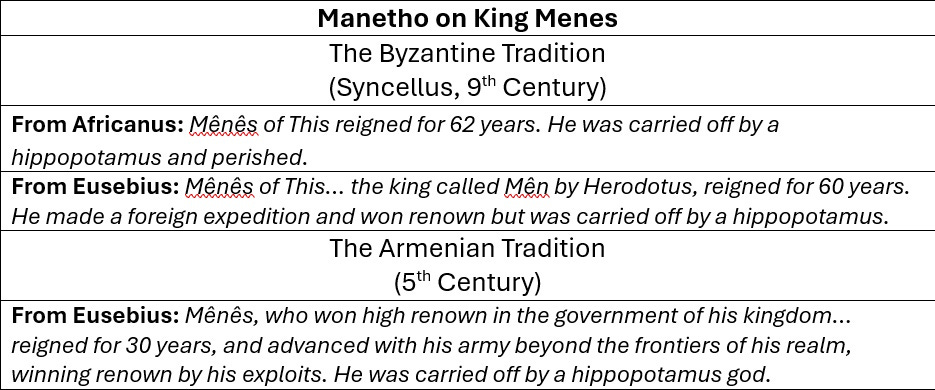
The Armenian tradition is even more explicit and provocative. In this version, also presented as Manetho’s account transmitted through Eusebius, Menes is said to have been killed by a hippopotamus god. While this wording cannot be proven beyond doubt to be either Eusebius’ or Manetho’s original phrasing, the Armenian translation is early and generally conservative, and it often preserves mythic elements that Christian writers had a habit of toning down. Read this way, the Armenian account no longer looks like an odd variant, or a subtle hint, but is a clear transparent echo of the Osiris myth itself: Menes is killed deliberately and not by accident, by the hand of a chaos-aligned villain in an animal guise whose most logical identity is the god Seth.
The Triumph of Horus Over Seth
From what survives of the ancient record, Manetho is the only source to offer an account of the death of Menes, the historical founder of Egypt’s First Dynasty. Manetho’s own background is obscure, though he is generally thought to have been a priest of Ra at Heliopolis. Fluent in Greek, he was commissioned by the Ptolemaic rulers to compose his Histories for a Greek-speaking audience, just as Berossos had done earlier for Babylon under Seleucid patronage. Modern historians place the publication of Manetho’s work during the reign of Ptolemy II (285–246 BCE), a period marked by active collaboration between the Greek monarchy and the Egyptian priesthood.
This collaboration deepened under Ptolemy III, named “The Benefactor” for his lavish support of temples and priestly institutions. In 238 BCE he convened a synod of Egyptian priests, resulting in the Canopus Decree, which formalized reforms and reaffirmed the alliance between the Greek royal house and Egypt’s religious elites. The decree represents a clear moment of ideological consolidation in which royal authority and priestly tradition were deliberately aligned.
Within this same political and religious context, construction began in 237 BCE on a monumental new temple complex at Edfu in Upper Egypt. Dedicated to Horus, this temple would become the most extensive and theologically elaborate Horus sanctuary in all of Egypt. Its walls preserve a detailed mythological program carved in relief and accompanied by long hieroglyphic inscriptions, particularly on the inner faces of the eastern and western enclosure walls. These reliefs do not merely allude to myth; they present a carefully staged sacred drama known as the Triumph of Horus, which was ritually reenacted and doctrinally authoritative.
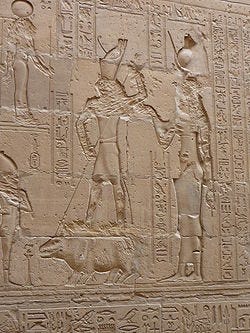
In these scenes, Horus appears as the avenger of his murdered father Osiris, prosecuting a cosmic and juridical campaign against Seth who is symbolized repeatedly and consistently as a hippopotamus. Horus is shown standing in a boat, harpooning the hippopotamus, while the Ptolemaic king joins the act, ritually striking the same creature. The accompanying texts identify this act as the judgment and punishment of Seth, framing the violence as both divine justice and royal duty. The hippopotamus is wounded, bound, pierced repeatedly, and ritually subdued, its destruction marking the restoration of ma’at and the vindication of Osiris.
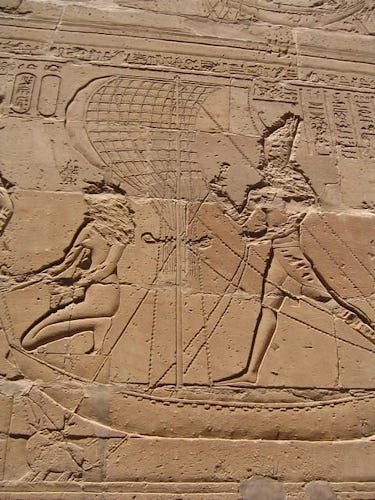
The drama (which can be read here) unfolds through a sequence of episodes in which the identity of the hippopotamus and the identity of Seth are explicitly fused. Isis speaks within the narrative, naming Seth directly while the assault on the hippopotamus is underway, leaving no ambiguity as to whom the animal represents. The repeated emphasis on harpooning the creature’s head, snout, and body underscores not only Seth’s defeat but the reenactment of a primordial crime—Seth’s murder of Osiris—now answered with divine vengeance.
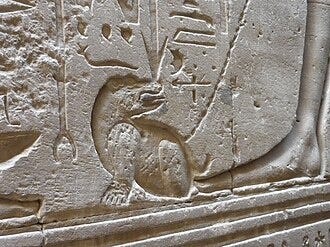
In the final scene’s inscription Isis, the wife of Osiris and mother of Horus, directs her son to have the slain Seth-hippo butchered and its various parts distributed to the gods, just as Osiris had been cut up by Seth and distributed to his accomplices, offering a grisly picture of retributive justice:
Your foes bow down and are destroyed for ever, O you Avenger of your Father. Come that I may instruct you. Consign his foreleg to the House of the Prince for your father Osiris… while his shank remains in Dep for your great father Ỉpy-shḏ. Let his shoulder be taken to Hermopolis for Thoth, the great one in the valley. Give his ribs to Great-of-Strength and his breast to Wnwt. Give the great meat-portion of him to Khnum in the Temple (?), his neck to Uto of the Two Uraeus-goddesses, for she is your great mother. Give his thigh to Horus the Primordial One, the great god who first came into being. Give a roast of him to the birds which execute judgement in Ḏbʿwt. Give his liver to Sepa, and his fat to the disease-demons of Dep. Give his bones to the Ḫmw-iyt, his heart to the Lower-Egyptian Songstress. Mine is his forepart, mine is his hind-part, for I am your mother whom he oppressed. Give his tongue to the Young Harpooners, the best of his inward parts to . . . Take for yourself his head, and so assume the White Crown and the office of your father Osiris. What remains of him burn in that brazier of the Mistress of the Two Lands. Rē has given you the strength of Mont, and for you, O Horus, is the jubilation. 10
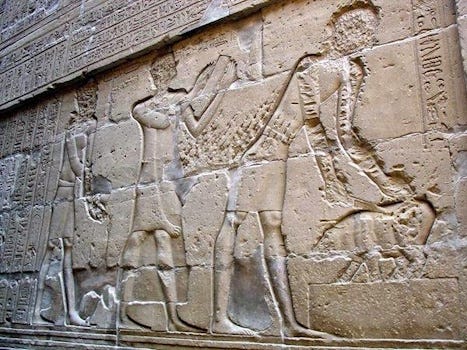
What the Edfu reliefs present, therefore, is not a late invention or a peripheral mythological curiosity, but an integral portion of Egyptian state theology in which Seth—specifically in his hippopotamus form—plays a central role in Egypt’s three-thousand-year narrative of kingship, justice, and cosmic order. It is a story told with absolute confidence in its outcome: Osiris the murdered king is vindicated; Seth, the agent of chaos and violence, is defeated and punished; and Horus the living king ascends the throne of a reunited Egypt restored to the divine order of maʿat. Far from being marginal, this myth stands at the very heart of Egypt’s understanding of legitimate divine rule.
Seen against this backdrop, Manetho’s account of the death of Menes—whether read as death by a hippopotamus or by a hippopotamus god—takes on a far sharper and more consequential significance. In either formulation, the allusions to Seth are unmistakable, and the manner of Menes’ demise closely mirrors the mythic pattern that had been associated with the death of Osiris since the time of the Pyramid Texts. The Edfu material makes clear that this association was not accidental or incidental. Manetho’s account of Menes’ death was purposeful and meaningful and was subsequently encoded within Egypt’s most authoritative temple theology at precisely the moment when Manetho’s history was being transmitted throughout the Hellenistic world.
Conclusion
What emerges from this investigation is not a speculative embellishment of Egyptian religion, but a unifying interpretive framework. Once the assassination of Narmer is taken seriously—not as a passing legend or a distorted Greek misunderstanding, but as a foundational trauma concealed beneath dynastic theology—the long-standing conundrums of early Egyptian religion begin to resolve themselves. The tensions within the Pyramid Texts, where Horus appears both as an ancient predecessor and as the son and avenger of Osiris; the abrupt prominence of Osiris as lord of the royal dead; and the insistence that each king will rule as Horus during life, but reign as Osiris after death, point to a single unresolved rupture at the very genesis of the Egyptian state.
Within this framework, the actions and characterizations of Narmer’s wife Queen Neithotep, and the successes of Hor-Aha the heir to the Horus-throne, become critically significant. They represent the stabilization of a realm thrown back into chaos by the violent removal of its founding figure. The memory of Narmer—carefully guarded within the priesthood, encoded in mortuary titles such as “Foremost of the Westerners,” and ritualized within the developing cult of the royal dead—was neither erased nor openly acknowledged. It was transformed.
Acknowledging the murder of a divinely sanctioned king as a human act would have shattered the ideological foundations of kingship itself. The solution was theological: the slain King Narmer was displaced into the realm beyond death and exalted as the god Osiris, Queen Neithotep’s character that was proven by her heroism emerged as the goddess Isis, while the royal couple’s heir Hor-Aha won the throne and ruled in life as Horus, maintaining the continuity of divine authority.
The full implications of this transformation extend well beyond the First Dynasty. The theological reformation that emerged from Heliopolis near the end of the Third Dynasty represents a deliberate act of statecraft. It was a reconfiguration of Egypt’s mythic architecture designed to reconcile an ancient tribal rivalry between Horus and Seth with the unresolved shock of Narmer’s murder. It is within this reformulation that Osiris, Isis, and the younger Horus are fully integrated into a new cosmological order—one that preserves the memory of the crime while neutralizing its political danger. Only by tracing this process can we understand how Egypt’s enduring religious system was forged not in timeless abstraction, but in response to a very real act of violence at the dawn of history.
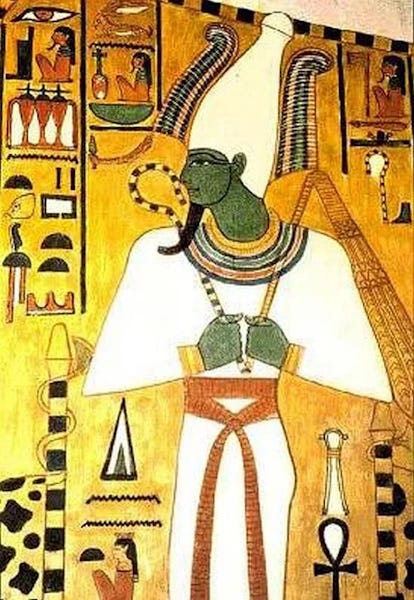
https://youtube.com/shorts/4ZKlX51I-r4?si=VCr39N_yuxc7Jor2
You are reading the Origins series from Sky Gods and Sacrifice
Read next: Catfish-Chisel Reborn: The Afterlife of the Murdered King
Go to Full Index
Peter Goodgame
December 17, 2025
Kailua, Hawaii
Ceiling inscription at the Temple of Hathor at Dendera. Translated by Émile Chassinat in Le Temple de Dendara, tome VI (1965), p. 141, lines 9–11 (Crypt 2, west wall).
Robert Bauval, Secret Chamber: The Quest for the Hall of Records (London: Century, 1999), pages 95–96.
Plutarch’s account is the first public account of the entire myth, but the first full Egyptian account, which brings together many of the narrative strands, can be found on the Stela of Amenmose. Known as the “Great Hymn of Osiris,” it dates to the New Kingdom circa 1450 BCE and is now located in the Louvre. An interlinear translation of the hymn can be found here.
Nicolas Grimal, A History of Ancient Egypt (Oxford: Blackwell, 1988), pages 47–48.
Mark W. Chavalas, “Menes,” Research Starters in History, EBSCO, 2023, https://www.ebsco.com/research-starters/history/menes
Inscription of the words of Isis: Act Three, Scene Three, from the Temple of Horus at Edfu.
See https://www.attalus.org/egypt/drama.html
I really should be more vocal about getting you on Archaix. Do you have any published books?
I know you'd both have a good time dismantling the magical 10500BC date. In fact, he's recently released a video analysing and disproving Hancock's theories in "Fingerprints of the Gods" by citing the ancient authors Hancock cites (like Eudoxus, Diodorus, Eusebius etc) and showing how each of them were aware that the Egyptians considered a the moon in their timekeeping, with their year being a moonth, rather than the 365 day solar year.
Excellent work showing us the origins of these mysteries. A lot more is making sense.
But how did this assassination work? Was Menes given a Hippopotamus ride by the Sethites as a gift with said hippo being trained to run wild and attack its rider? Perhaps after the hippo-mauling the Sethites get a hold of Menes and deal the finishing blow.
Or maybe, the hippo riding was a challenge? Maybe it was a sort of game or contest and Menes was to prove his valour. Being carried away rather than attacked seems to carry this sense.
I have yet to really incorporate an understanding of Egyptian symbolism into my system (MSA). But I do like that you are doing this research. It helps. Good writing as always! Thanks for mentioning Graham Hancock et al and contextualizing him. Cayce, and the Freemasonic use of Atlantis is another thorny area for me.