
Ancient Sumer, Silicon Valley, and the Shadow of Sauron

It’s no secret that Peter Thiel is fascinated with JRR Tolkien’s mythic universe. Indeed, as pointed out in a May 23, 2025, NY Times article, (no-paywall summary here), symbols and references within The Lord of the Rings have become like a private dialect or insider code for Silicon Valley at large. More than just nostalgia, Tolkien’s works have shaped the values and the identities of some very powerful players.
Let’s start with Palantir Technologies. Co-founded by Peter Thiel back in 2003, it’s named after the magical seeing-stones in Tolkien’s universe. The symbolism is key: Palantir seeks to evoke the power of omniscient vision in marketing its AI-powered and surveillance-focused software systems. But the irony is unavoidable. Within Tolkien’s story the palantír stones were dangerous tools that corrupted both Saruman and Denethor, binding them under the power of Sauron. They captivated through a promise of wisdom and knowledge, but at their core they were instruments of corruption and domination.
And speaking of domination, after more than fifteen years of working with the U.S. military, Palantir in July of 2025 secured a new $10 billion deal that cements its role as the Army’s ‘digital nervous system,’ a system through which battlefield logistics, targeting, and real-time intelligence now flow.
Palantir has won. They are now the digital brain behind the US war machine, the tip of the spear of a global Empire that continues to pursue full-spectrum dominance.

Another company with a Tolkien-inspired name and a key role in the US military-industrial-complex (MIC) is Anduril Industries. Started in 2017 by a number of Palantir and SpaceX linked investors, it was initially funded by Peter Thiel’s own Founders Fund. The company specializes in producing AI powered drones, (both aerial and underwater), semi-portable surveillance towers, as well as an augmented reality system (IVAS) being built in partnership with Microsoft for use by soldiers on the battlefield. A blogger known as Paris Marx explains the Tolkien tie-in:
The company is named after a sword whose elvish name translates to Flame of the West. It was forged from the shards of Narsil, the sword of the King of Gondor that was used to cut the One Ring from the hand of Sauron… In the black-and-white morality of the series, the sword is a symbol of good; of the triumph of the Free Peoples of Middle-earth against the darkness spreading from Mordor. That might seem to be in conflict with an evil weapons company, but if you’re a right-wing extremist who believes in the story of US greatness, a weapons company provisioning the US military for geopolitical conflict with the non-Western world might fit into such a story quite well. Flame of the West indeed.

Other Silicon Valley ventures linked with Thiel that tap into the Tolkien mythos include Narya Capital, Rivendell One, Rivendell Trust, Lembas Capital, and Mithril Capital Management, where Thiel first employed J.D. Vance back in 2016. Again, refer to Paris Marx for more on these and several other Tolkien connections in Silicon Valley.
Peter Thiel claims to have read The Lord of the Rings trilogy at least ten times. Yet he is not alone among Silicon Valley’s titans in his devotion to Tolkien. Two other Tech Lords must be counted here as well: Jeff Bezos and Elon Musk—both of whom have openly acknowledged how Tolkien’s work shaped their early years.
Bezos followed through on his obsession in 2017 when Amazon purchased the rights to the LOTR backstory for $250 million, which became the Rings of Power streaming series that aired in 2022.
Elon Musk may not have any directly Tolkien-related investments, but he’s on the record as being a huge Tolkien-admirer, saying that the characters from the LOTR helped to instill in him a duty to save the world. It follows then, that Musk was very vocal in his criticism of Amazon’s Rings of Power series, remarking that it failed to provide any strong heroic male characters!
These two Tech Lords interact as rivals yet they share, along with Peter Thiel, a common vision for the future.
The Techno-Authoritarian Vision
The gods of Silicon Valley believe they are on the verge of shipping us a new way of being human. Some call it post-human or trans-human. Through emerging technologies they are offering us the same old promises that Civilization has always whispered—freedom, convenience, comfort, safety. These technologies include the following:
Surveillance & Control – all-seeing data nets, biometric ID, Palantir-style omniscience, 24/7 surveillance and tracking.
Sky Dominion – Starlink satellites, NASA, SpaceX and Blue Origin, space weapons, planetary colonization projects.
Post-Human Biology – CRISPR gene-editing, synthetic wombs, biohacking, longevity strategies, digital/mental uploading, neural implants, cyborg hybrids, eternal life.
Intelligent Machines – self-driving cars, robotics, Anduril weaponized drones, nanotech swarms.
Finance – instant transactions, crypto and blockchain, commodification of everything, digital and algorithmic domination of global commerce.
Artificial Intelligence – strategic and tactical AIs for every conceivable use case, the proliferation of data centers, autonomous social media engines, AI gatekeepers to manage dissent and promote and protect the narrative on all media platforms 24/7, AGI.
Energy and Climate – geoengineering, sun-blocking, rain seeding, CO2 collectors, wind, solar, tidal, nuclear, fusion, smart batteries, smart grids.
Cultural Engineering – algorithmic entertainment, education control, endless advertisements everywhere, mimetic desire unchained, propaganda and artificial storyselling: the Empire defines our enemies and victory is pursued at all cost.
These are eight areas of emerging tech that may potentially shift the entire trajectory of the human race in the near future. But let’s add a ninth to embrace some Tolkien symbolism and touch on the subject of NHI:
Exotic Tech (UAP Stream) – anti-gravity, metamaterials, free energy, inter-dimensional gateways, psionic assets, breakthroughs in understanding and engineering plasma, and perhaps even weaponizing consciousness itself.
Nine rings for mortal men, doomed to die.
The Tech Lords of Silicon Valley are the smartest and most influential people on the planet. Their wealth is obscene and their power is unprecedented. In fact, if you pull up a list of the top ten wealthiest individuals in the world, eight of them have direct Silicon Valley connections. Thiel is not on the list, and so we have (according to Grok AI) in addition to Musk and Bezos, Ellison and Zuckerberg, Larry Page, Ballmer and Gates, and Jensen Huang whose Invidia Corp makes the chips that power this particular vision for humanity’s artificial future.
We will now contrast our present moment in history with the birth of Civilization itself in another valley over 5000 years ago: the valley of the Tigris and Euphrates in Mesopotamia. But first let’s look at how the mythos created by JRR Tolkien can act as our bridge. The Shadow of Sauron looms large over Silicon Valley, and we’ll see that it extends to ancient Sumer as well.
Tolkien’s Inspiration
JRR Tolkien was a keen student of mythology and an expert on ancient history. The world he created, epic in scope and defined by a stark and unambiguous battle between good and evil, was born from his endless hours of study and research and from his Christian faith. In his personal papers and his interviews he explains some of the inspiration for his plot lines and the languages that he invented.
For instance, Tolkien created two Elvish languages: Quenya, which was inspired by Finnish, and Sindarin, which was based on Welsh. Here is Tolkien remarking on his introduction to the Finnish language,
It was like discovering a complete wine-cellar filled with bottles of an amazing wine of a kind and flavour never tasted before. It quite intoxicated me. 1
Regarding the Shire and the laid-back pipeweed-smoking community of the Hobbits, Tolkien explains:
The Hobbits are just rustic English people, made small in size because it reflects the generally small reach of their imagination—not the small reach of their courage or latent power. 2
Tolkien’s story of the epic downfall of the island empire of Numenor, the backstory to the LOTR which is portrayed in Amazon’s Rings of Power series, has an obvious parallel which was confirmed often by Tolkien:
This legend or myth or dim memory of some ancient history has always troubled me… I call it my Atlantis complex. That legend haunts me. 3
The Downfall of Númenor is partly derived from the myth of Atlantis, but was blended with my religious view: the notion of a great people, proud and mighty, destroyed by their rebellion against divine authority. 4
Tolkien also wrote that the Rohirrim were inspired by the Anglo-Saxon people, and explained his inspiration for crafting their language:
The language of Rohan I have represented by Old English, since it was related to but distinct from the speech of Gondor, just as Old English is related to but different from modern English. 5
Tolkien is often criticized for elevating the archetype of the heroic white male at the center of his mythology. Yet at the same time his work also subverts this ideal: the fate of Middle-earth ultimately rests not on kings or warriors, but on the courage and perseverance of humble hobbits. Even so, Tolkien was very much a product of his time, and by contemporary standards his worldview shows clear limitations and would not stand up to today’s ideals of inclusivity or political correctness.
This conclusion is supported by Tolkien’s characterization of the forces of evil in Middle-earth. Brown and black-skinned humans do appear, but only as invaders from the South and East, marching under the Dark Lord’s banner, coming to terrorize the noble and peace-loving Caucasians of the North. Orcs, too, are often described with racialized terms such as “slant-eyed” and “swart,” and the language they speak is literally called the Black Speech.
So this brings us to the question of the forces of evil. What were the inspirations guiding Tolkien’s hand as he crafted Middle Earth’s villains, other than his unintentional racial biases? From what we know from Tolkien himself there were three primary influences:
His Christian theology.
His personal experience, both as a soldier in World War I, and as a suburban English citizen troubled by industrialization.
Norse and Germanic myths, which inspired many of Tolkien’s monsters and his apocalyptic themes.
But there is another major influence that shaped Tolkien’s understanding of the forces of evil in Middle Earth. He never specifically mentioned it, not in any of his interviews or letters, but the evidence is there. Tolkien was undoubtedly influenced, consciously or not, by the histories and myths of the birth of Civilization in ancient Sumer.
Enter the Uruk-hai
The shock troops of the Dark Lord Sauron are the Orcs. The lore tells us they were created by the original villain Morgoth through a brutal yet effective genetic corruption of captive elves thousands of years before the Third Age of Middle Earth. This corruption was physical as well as moral. Orcs were pure evil, generally weaker than elves but often on par with humans, and unable to endure sunlight. They were literally creatures of darkness, dwelling in mountain caves and the underground levels of the Dark Lord’s strongholds.
Near the end of the first book of the LOTR we are introduced to a new breed of orc that is bigger, stronger, and able to function normally in sunlight. In their marching chants they call themselves the Uruk-hai, but that is simply a generic term meaning “orc folk.” Uruk means “orc,” and hai means “folk.” The orcs are Uruk-folk.
Tolkien named his villains after the Sumerian city-state of Uruk, the first true State in human history. With a ruling hierarchy, a bureaucracy, a written system of accounting, and a system of taxation, the rise of Uruk was truly a remarkable achievement. For a time the city of Uruk and its empire was absolutely unrivaled in the ancient near east, enduring for a couple of hundred years before collapsing around 3100 BCE.
The book of Genesis refers to Uruk as Erech, describing it with implicit negative undertones as the first kingdom in human history. Today the name of the modern nation Iraq is simply yet another spelling of the original name, Uruk.
The story of Civilization’s origins was uncovered in the 19th and early 20th Century. Written clay tablets were discovered and the Sumerian language was deciphered. Uruk itself was excavated, with high points of discovery becoming front page news throughout the world during the 1910s and into the 30s. This was the same time that Tolkien was beginning his academic career and before he started writing the LOTR. Clearly Uruk was “in the air” when he started to build his mythical world.
The parallels continue when we compare Tolkien’s Black Speech with the Sumerian language and the closely-related Akkadian tongue that came after. Let’s look at the names that Tolkien gives for some of his orcs:
Azog was an orc chieftain and feared ancient enemy of the dwarves. In ancient Sumer Asag was an Akkadian death demon and bringer of plague.
Bolg was the son of Azog and leader of the orcs at the end of The Hobbit. In the book Bolg is slain by Beorn, but in Peter Jackson’s film he is slain at the end of a long and unnecessarily drawn out fight scene by (who else?) Legolas. In ancient Sumer, Balag is a ritual lamentation death hymn, or a musical instrument, both linked to death and doom.
Ugluk is the captain of the group of orcs that capture Merry and Pippen with orders to take them to Saruman. In Sumerian the word Ugula means “overseer” or “taskmaster.”
Grishnakh is captain of the Mordor-based orcs tasked with working with Ugluk’s band, who would prefer to eat Merry and Pippen rather than take them to Saruman. Gurush is a very common Sumerian word meaning warrior, laborer or youth, while the word nakru in Akkadian is enemy or stranger. Nakhash in Hebrew is serpent, as in the Garden of Eden.
Muzgash is an orc serving at Cirith Ungol who gets caught up in fighting over Frodo’s mithril shirt. In Akkadian incantations both Mashgash and Musgasu are names of demons.
Snaga is an orc name that appears a couple of times as a pejorative meaning “slave.” In ancient Sumer a sanga was a temple official or priest.
Let’s look now at place names in Mordor. First of all Mordor itself is phonetically similar to Marduk, the warrior god of Babylon. But stay with me, we can do better…
The fortress of Sauron’s evil empire is Barad-dur which literally means Dark Tower in Black Speech. In Sumer the word bara means “royal throne” or “temple sanctuary,” or it could be used as a negative prefix meaning “ do not” or “against.” The word du means “build” or “establish.” So in Sumerian “bara-du” could mean either “established throne,” or “forbidden to be built” echoing the Tower of Babel legend from the book of Genesis that also took place in ancient Sumer.
In the LOTR, Udûn is the northern valley of Mordor, just inside the Black Gate. It is a desolate, militarized wasteland filled with forges and war-works. It’s an industrial hellscape that channels the volcanic fires of Mount Doom into Sauron’s war machine. Tolkien’s use of Udûn evokes not just fire and destruction, but also the imagery of hell itself.
In Sumerian, the word udun refers to an oven, kiln, or furnace — a place of consuming fire. This linguistic echo is uncanny: Tolkien’s Udûn functions as the industrial furnace of Mordor, and the ancient Mesopotamian udun denotes the literal furnace of fire. In Mesopotamian life, fiery furnaces were linked to sacrificial or industrial transformation (burning, baking, smelting, forging). Tolkien captures this archetype perfectly: Udûn is where Sauron forges domination through fire, perverting creation into the service of mass destruction.
And what about the name Saruman? Beyond its Old English root (‘cunning man’), it bears an uncanny resemblance to the word Sumerian.
Lastly we have to deal with Sauron. Tolkien’s purest symbol of raw and unredeemable evil, the Dark Lord himself. In Tolkien’s story Sauron was created as an angelic Maya entity who became corrupted by Morgoth in an earlier age. He’s literally a fallen angel. The name Sauron is explained as coming from an elvish root saur- meaning corrupted, foul or putrid, so Sauron is interpreted as The Foul One.
However if we look to ancient Sumer we see that Šar/Šarru means king in Akkadian, and Šaru means tyrant. Obviously this connection might apply as well to Šaru-man.
Another Sumerian figure that may have influenced Tolkien is Sargon of Akkad, the founder of the Akkadian Empire whose reign marked the ascendency of the Akkadian language that eclipsed ancient Sumerian around 2300 BCE. Again, Sauron and Sargon are a close phonetic match.
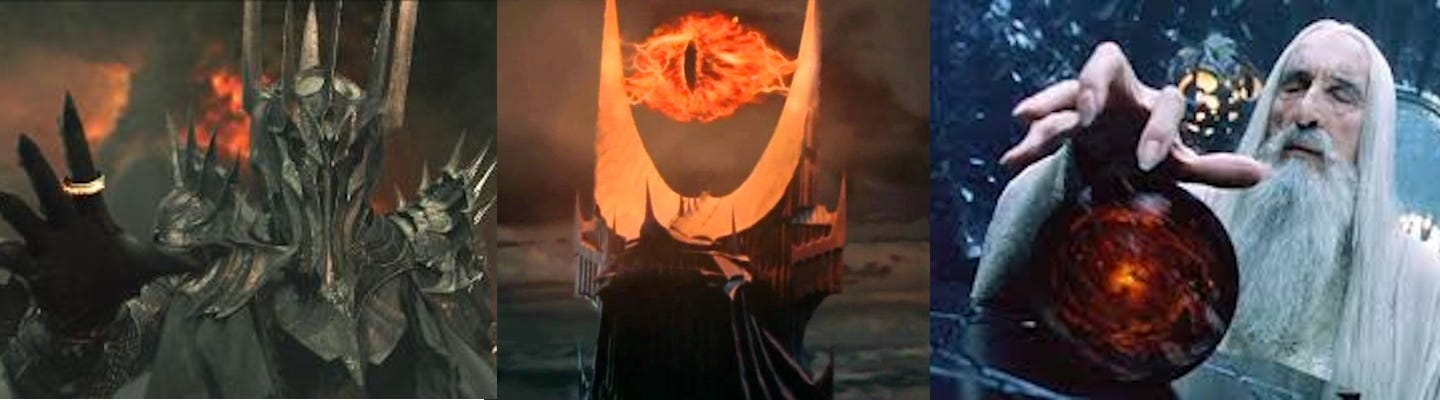
Tolkien never revealed that he studied Sumerian or Akkadian lexicons to find names for the forces of evil in his mythic narrative, yet the evidence suggests that might certainly have been possible, if not likely.
On the other hand, who can explain how creativity actually works? Was it possible that Tolkien acted in some sense as a channel? Was his consciousness and his creative process influenced by “downloads” from an outside source?
I’m sure for most people this possibility sounds ridiculous, but for those intently following the ongoing research into NHI contact and evidence of ongoing narrative manipulation (read Jacques Vallee) this goes with the territory. Just keep an open mind as we move ahead, and trust Tolkien’s instincts.
Sumer’s Tech Boom and the Uruk Expansion
The Uruk IV period, roughly 3300–3100 BCE, marks the moment when an extraordinary cluster of new technologies appeared almost simultaneously, transforming the habitation of Uruk into the world’s first regional superpower.
Before this burst of innovation Uruk was already a thriving settlement on the banks of the Euphrates. Its society was stratified, with slaves and laborers at the bottom and priests and kings at the top. Temples to Anu and Inanna presided over a surplus economy of grain, pottery, textiles, and brickmaking. Caravans and boats carried goods in and out, linking Uruk to neighboring regions. Yet in these respects, it was still much like all the other settlements of the Fertile Crescent.
The invention that truly set Uruk apart was writing. Not for stories or poetry, but writing as an accounting system to track grain surpluses, manage the labor force, organize rations, assess taxes, and most importantly to encode credit and contracts. With the new technology of writing Uruk unleashed its economy to expand beyond anything the world had ever seen.
Other innovations amplified this effect: the fast-spinning potter’s wheel, large-scale production of wool textiles, the deadly pear-shaped mace, the first forays in bronze metallurgy, as well as monumental architecture designed to awe citizens, intimidate enemies, and elevate the city’s prestige.
At the height of its development the Late Uruk culture included the following elements: a capital of indisputable preeminence, Uruk itself measuring one hundred hectares, with its sacred and organizational center at the Eanna precinct; a central territory that embraced all of Lower Mesopotamia… and Khuzistan (Susa); a zone that we can define as the semi-periphery, Upper Mesopotamia, with a mixed culture; and a zone with commercial outposts distributed over the Anatolian and Iranian highlands. 6
Archaeologists of the Uruk IV layers consistently find two artifacts above all: clay tablets for accounting, and bevel-rimmed bowls for rationing. Regarding the tablets, James Scott observes, “The topics of the surviving tablets in order of frequency are barley (as rations and taxes), war captives, male and female slaves.”7
The dark side of Uruk’s rise was the fact that human labor was the prime commodity. The Uruk-folk at the bottom of the social ladder were a grim lot, harnessed for construction, industry, agriculture, and conscripted for war. Uruk deployed garrisons in distant colonies, trained elite royal guards, and organized large-scale mobilizations far beyond the tribal scale of earlier eras. And being equipped with the pear-shaped mace in a time before the invention of armor further ensured their supremacy. 8
The outward growth of this innovative experiment is known as the Uruk Expansion, and historian Guillermo Algaze refers to its empire as the Uruk World System. To sustain its credit economy the city grew to dominate lower Mesopotamia and planted fortified colonies as far away as Anatolia and Iran. Much like a startup in relentless growth mode, these outposts functioned as satellite offices strategically positioned to secure resources, manage supply chains, and project Uruk’s power. 9
At the heart of this system stood the “House of Heaven,” the Eanna Complex, which was the sacred economic precinct dedicated to the goddess Inanna. It functioned as the central data center of its age. It was the hub where grain credits, labor quotas, and resource flows were recorded and controlled. All the wealth of the realm passed through its gates, funding continual renovation and expansion, and adorning the precinct with ever-grander monuments. Chief among them was the spectacular towering central Temple to Inanna itself, which was both economic headquarters and symbolic showcase that projected Uruk’s supremacy far and wide.
Uruk’s rulers were innovative and ambitious. Their organizational skill outpaced their rivals, their woolen textiles were prized across the Near East, and their credit system allowed them to borrow against the future, mobilizing labor and attempting projects never before imagined. But credit also meant debt, and this meant that expansion was no longer optional, it was baked into the system. The ruler of Uruk was both warlord and CEO, and above all his role was to keep the machinery of expansion running, regardless of the human cost.
The Collapse
The city-state of Uruk became the model for virtually every State that followed. All of them were born out of grain-based economies, all of them used written accounting systems and taxation, all of them ruled from a centralized hierarchy, all of them carried out their will with armies and organized labor, and all of them legitimized their rule through rites, rituals, and monumental displays of power. Uruk established the framework and Civilization has followed the same pattern ever since.
There is one more thing that is inherent to this framework: Every single State that has started down this road has collapsed. It’s the final end of all debt-based expansionist systems.
… this system [Uruk IV] had a short lifespan of only a couple of centuries. The settlements of the periphery were destroyed or abandoned, and the long development of the Eanna center was interrupted. It seems, therefore, that the first period of urbanization faced a crisis or a real collapse, after a long formative phase and the culmination of its internal organization (writing) and commercial expansion (colonies). 10
By 3100 BCE, Uruk had matured into a full blown credit-based economy. Clay tablets from the late Uruk period are full of tallies of barley and silver owed, interest-bearing debts, and contracts enforceable through temple authority. In other words, Uruk was running on faith in future repayment. Every year the system had to generate more barley, more wool, more copper, more tribute, more slaves. Uruk was dependent upon positive GDP growth year-over-year. This is what drove the Uruk Expansion into Syria, Anatolia, and Iran. It was “expand or die.”
At its high point debt inequality must have been extreme, with creditors at the top made up of wealthy merchants and industrialists and well-connected members of the ruling class. At the bottom were the debtors: farmers whose crops had failed, merchants whose products had been lost, and day-laborers with no safety net when the harvest fell short. A single bad season or a lost boat or caravan could push a household into arrears. What began as a loan to cover seed or supplies often spiraled into unpayable obligations.
For the elites this system was immensely profitable. Creditors could seize livestock, tools, and even land as collateral. In the most desperate cases, debtors and their children could be taken into bondage, working as household servants or agricultural laborers until their debts were nominally repaid. In practice this meant a steady flow of labor and resources moving upward into the hands of those who already had the most.
Meanwhile, resentment simmered at the bottom. The majority of the population lived perpetually on the edge, forced into dependency and stripped of the freedoms their ancestors had enjoyed. Villages that had once been relatively self-sufficient found themselves bound to the demands of the great city. The cycle of debt reinforced hierarchy as the top households grew stronger and more entrenched, while the common Uruk-folk became increasingly vulnerable to exploitation.
In the Eanna Complex itself the sense of euphoria based on optimism in Uruk’s advanced tech stack gave way to tension. One bad report could spark a “bank run” with creditors rushing to the Temple demanding to be paid, or angry mobs eager to destroy debt records while seeking for their creditors’ heads.
Historians cannot say exactly what brought about the end of the world’s first tech bubble, but the archaeological evidence is crystal clear when it happened.
Archaeological evidence shows a major disruption to Uruk’s Eanna precinct around 3100 BCE. With the Temple economy broken, both the empire and its complex financial system imploded. Uruk the city staggered on, but the Uruk World System with its colonies, its debt regime, its incoming streams of tribute, that was all finished. Liverani explains,
In the periphery, where urbanization was quite modest and the administrative apparatus extemporaneous, the collapse was total. A colony such as Habuba Kabira, which had been founded on virgin soil, was fully abandoned. The commercial outposts inserted in indigenous zones, such as Godin Tepe or Hassek Höyük, disappeared, leaving the local settlements to their own fate. Even in Susiana … the Late Uruk interval ended as suddenly as it began. At the opposite end of the Near East, the indigenous center of Arslantepe, with an early state organization, saw the destruction of its Late Uruk period temple complex. 11
So what happened back in Uruk? Was there an incursion or a civil war? Was the Eanna Complex overrun by angry mobs? Was its massive silver stockpile carried off and its huge library of debt records smashed? Although certainty is elusive, the circumstantial evidence favors such speculation.12 In any case, what is clear is that after the smoke cleared from the collapse Uruk’s authorities decided to erase the damaged complex entirely. The buildings of the Eanna precinct were completely leveled and razed to the ground and construction of Uruk’s sacred economic headquarters had to begin anew.
When archaeologists in the early 20th Century finally excavated these newer buildings, they found that their platforms were packed with thousands of broken clay tablets. Once essential records of the Uruk IV economy, they had lost all value and had been discarded as fill for the foundations of the new structures.13
So what was the shock that brought down the world’s first superpower? As this series continues we’ll turn to the work of Peter Thiel’s other great influence, social theorist Rene Girard, to help us reveal some very… well, some very profound, some might even say explosive, connections and events that have been, yes, hidden since the foundation of the world.
The Origins series from Sky Gods and Sacrifice
Read next: Flight of the Falcon Tribe: Egypt Rises on the Wings of Imported Tech
Or go to Full Index
Peter Goodgame
September 3, 2025
Kailua, Hawaii
J.R.R. Tolkien, The Letters of J.R.R. Tolkien, ed. Humphrey Carpenter, with Christopher Tolkien (London: George Allen & Unwin, 1981), Letter 163.
Letter 27
Letter 257
Letter 254
Letter 144
Liverani, Mario. Uruk: The First City. London: Equinox Publishing, 2006, p. 73
Scott, James C. Against the Grain: A Deep History of the Earliest States. New Haven: Yale University Press, 2017, page 133
In Tolkien’s War of the Last Alliance Sauron wields a great black mace.
Algaze, Guillermo. The Uruk World System: The Dynamics of Expansion of Early Mesopotamian Civilization. 2nd edition. Chicago: University of Chicago Press, 2005.
Liverani, Mario. Uruk: The First City. London: Equinox Publishing, 2006, p. 73.
Liverani, Mario. Uruk: The First City. London: Equinox Publishing, 2006, p. 73-74.
Crawford, Harriet. Ur: City of the Moon God. London: Bloomsbury, 2015. p. 42.
“The end of the Uruk period … seems to have been marked by retrenchment in Mesopotamia; for example, the major Uruk ‘colonies’ were destroyed or deserted... At Uruk, the whole of the Eanna precinct was cleared, and a new platform made. Whether the late Uruk buildings were destroyed by enemy action or merely levelled so that new, more elaborate structures could be erected we shall never know.”
Englund, Robert K. Archaic Administrative Texts from Uruk: The Early Campaigns. Berlin: Gebr. Mann Verlag, 1994, p. 23.
”In the Eanna precinct, the construction of the Uruk III temples involved leveling the earlier structures and creating new platforms. Among the fill materials were large quantities of discarded clay tablets, primarily administrative texts from the Late Uruk period…”
Wonderful read. Thank you!